Understanding COMT: why some supplements make you feel great (and others terrible)
Ever felt wired, anxious or completely flat after a B vitamin or a focus supplement? Your COMT gene may be part of the reason. This recorded live session explains what the COMT enzyme does, what slow and fast COMT mean, and what tends to help each, with viewers' questions answered at the end.
 The full articleCOMT Warrior vs Worrier: Slow and Fast COMT SupplementsRead it, with every source
Transcript
Under the same chapters as the video. Press a time to play from there.
[Transcript of the teaching part of the session, 5:40 to 35:35. The live questions and answers that follow are not transcribed.]
5:40 What COMT does in plain English
Host: So what is COMT? COMT is catechol-O-methyltransferase. It's an enzyme in your brain, liver and body. Its main job is to break down and clear away excess dopamine, norepinephrine and epinephrine. It also handles catechol estrogens, which are reactive estrogen metabolites, which we'll talk about a little bit more further down.
So what are catecholamines? So dopamine, that chemical is in charge of motivation, focus, pleasure and drive. Norepinephrine, attention, alertness and memory molecule. And epinephrine, a fight or flight adrenal response. So too much of these leads to anxiety, wired but tired and feeling irritable.
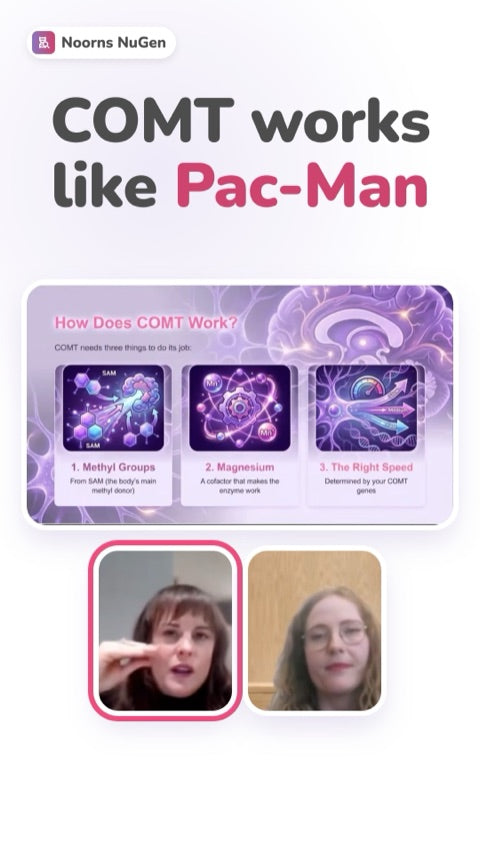
Too little of these can lead to low mood, flat mood and trouble focusing. Again, you are much more than just this one gene for any of these topics, but we're focusing on the COMT one today. So how does COMT work? COMT needs three things to do its job. So in my head, the way COMT works is I think of it like Pac-Man.
So it kind of, it takes a catechol molecule, whether it's dopamine or estrogens, and it kind of eats it. And then it goes down and can be activated in your receptors. It's actually attaching a methyl group to it, but it's kind of more fun to think of it as Pac-Man.
So we have really fast Pac-Man, fast COMT, and we have a really slow Pac-Man, which is very slow at degrading things. And then we have the intermediate, which is chugging along just fine. So methyl groups, which the main methyl group in our body is S-adenosylmethionine or SAMe, magnesium.
And then you need the right speed of COMT, which is governed by your genetics, but also your environment, because COMT is very sensitive. So what speeds it up and what slows it down can also comes from your diet and your supplements.
7:39 Val158Met (rs4680) and “Warrior vs Worrier” as a spectrum
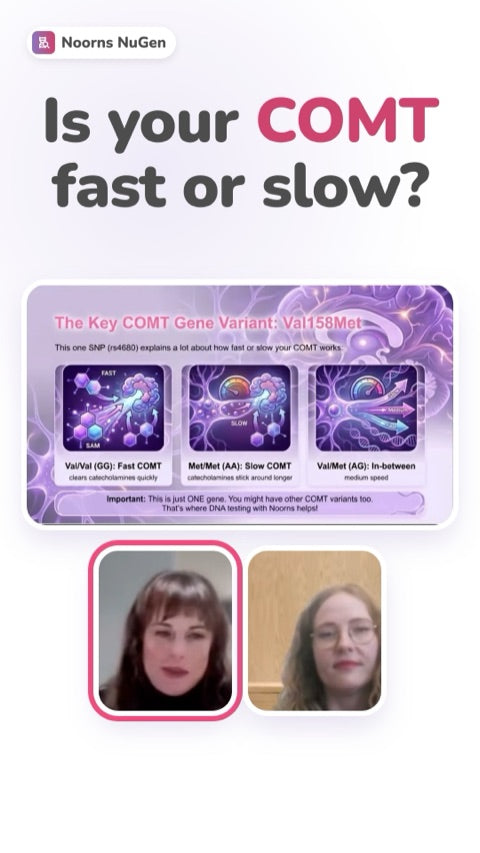
Host: So the COMT variant we're going to talk about today is the Val158Met. It's also noted on some reports as the SNP rs4680. So there's three states, well, there's three states for every team, but the three states for COMT that everybody's heard about is the fast, or the Val/Val GG type of COMT.
This one clears the catecholamines really quick. So your Pac-Man is chugging along fast. And the Met/Met is the slow COMT, which is the slow Pac-Man and the catecholamines are sticking around longer. And Val/Met is the AG and it's everything in between. So that one has one fast allele and one of the slow alleles.
So there are other variants on COMT, but the rs4680, the slow COMT can be inhibited as much as possible. It can be inhibited as much as 40% on just that one SNP. The other ones are usually cumulatively significant. But individually, if you only have one slow of the other variants, it's not usually as impactful, usually as impactful.
There's always exceptions. All right, so our first COMT we're going to talk about is the warrior, the fast COMT. So the good stuff about this genotype is you are usually calm under pressure. You usually handle emergencies very well, not overly anxious. The possible negative side effects of this genotype is that you can feel flat or unmotivated, like not finding joy in things as much as you used to find joy in things.
If you have trouble with memory and focus, you may need more stimulation to feel on the fast COMT tend to also be thrill seekers, like they're always looking for that dopamine surge because they go through their dopamine so quickly. So if you're doing something very exciting, something very pleasurable, you're getting more of that dopamine fix.
And we'll talk about supplements for increasing dopamine and slowing down COMT for the warrior genotype towards the end. We are going to focus a little bit more on the slow COMT, the warrior type in the beginning now, but we will cover all three. So the good stuff about the warrior, because there's not all bad, but you are good at great working memory, detail oriented and being thorough, good at learning and planning and good at focusing.
The challenges is that you can be more anxious, overthinking sensitive to caffeine and other stimulants. You get that wired, but tired feeling and the trouble shutting off. And so then, and then the, sorry, I don't have a slide on the intermediate one, which is one allele of both.
Again, you're kind of chugging along and just quick, fine with fast and slow. So you're more stable. So COMT and estrogen metabolism, this one, we get a lot of topics in the group, right, [guest]?
Guest: Yes, yes. Yeah. Very intricately linked. A lot of perimenopause and just people, slow COMT individuals who struggle with estrogen dominance. Absolutely. Mm-hmm.
Host: So COMT breaks down estrogen. So it breaks down catechol estrogens into 2-hydroxy and 4-hydroxyestradiol. These catechol estrogens can be reactive and potentially damaging to DNA. This is how estrogen, the detoxification, this is why it's important in the context of cancer.
And also once COMT degrades these estrogens into the protective, safer detoxification forms, is that you have to make sure they're getting excreted from your body. So this means a healthy digestive system. If your digestive system is not optimal, operating at full speed.
So this means steady bowel movements if you have constipation issues. The problem is that these estrogens can then get reabsorbed through your intestinal wall, back into your bloodstream, and then they need to be detoxified again. So you need to make sure that you have lots of fiber, good probiotics, and that you're excreting these estrogens as they're getting detoxified, like metabolized by COMT.
11:43 Why do supplements affect everyone differently?
Host: So why do supplements affect everyone differently? Two biochemical levers are the main things for COMT. One is your methyl load and two is your catechol load. So how many methyl groups are being pushed into your system? This would be taking things with the word methyl in it, like methylfolate, which is a form of folate.
Methylcobalamin, which is methyl B12. S-adenosylmethionine or SAMe, trimethylglycine, and choline. Choline is not a direct methyl donor, but I'll talk more about choline and why it's usually listed as one in a second. And the catechol load, so how much dopamine, norepinephrine, and epinephrine are being produced?
Are you taking supplements that increase these, like tyrosine, L-DOPA, and high caffeine consumption? When you have slow COMT, you're already being behind on clearing the catecholamine. So again, your Pac-Man is just chugging along very slowly. So when you take methyl donors, you push COMT activity to spike.
Dopamine surges and then it crashes, and this leads to the agitation, irritability, and the amped and crashed feeling. If you push dopamine boosters too high, so too much dopamine is produced, the slow COMT can't keep up. Anxiety, insomnia, and the wired feeling is the result of that one.
Supplements to use with caution with slow COMT. So high doses of methyl donors. Again, the methylfolate, methylcobalamin, SAMe, TMG, and high doses of choline. So we all need methyl donors. Methylation is our fundamental biochemical process in our body. So most people probably heard of MTHFR, which is our main production of methyl groups.
If you're interested in more methylation, let us know in the comments, and we can make a video on talking about methylation in MTHFR. Our backup system is MTHFD1. Our backup system is MTHFD1. So if you have variants in MTHFR, and that one uses the B vitamins and folates and B12 to make methyl groups, but you don't have variants in MTHFD1.
You can take choline, which is its source, to make methyl groups from MTHFD1. So high doses of choline are used by MTHFD1 to produce a lot of methyl groups. So if you take choline, you will end up with more methyl groups. But it's not a direct methyl donor in the same sense as if you take methylfolate or S-adenosylmethionine.
That's a direct methyl donor. So yeah, if you have MTHFR variants, look to choline. You can have that as a regular methyl donor if you're having problems making methyl groups through your B vitamins. Or if you don't tolerate folate or B12 at all, you can always try choline as your backup system.
Eggs are a great source of choline.
Guest: Yep, egg yolks are the best sources of choline.
Host: So, yeah. Sorry, I got a little bit distracted there. Yeah. We do get in the group a lot of times. Like I took a methyl group and I felt amazing for the first time in my life for like a day or two and then people crash. I think we have a lot of comments that that's the case because you need the methyl group so you're not producing enough on your own.
But the problem is you get that surge and then that crash and coming down after it and not getting another surge when you take them again or you stay at the anxious, irritable and exhausted problem. So supplements to use with caution, anything that's a strong dopamine booster.
So tyrosine, DLPA, L-DOPA, Rhodiola rosea, usually stuff that's sold as a focus supplement. Those are usually very bad for slow COMT people because they increase dopamine and norepinephrine faster than slow COMT can handle and can clear them, which worsens the anxiety, insomnia and the wired states.
So for slow COMT, if you're pushing the gas pedal with dopamine, it usually backfires when you need to be trying to fix your brakes with your COMT efficiency first. So better approach for slow COMT is magnesium. That's the big cofactor for COMT is calming 200 to 400 milligrams a day.
16:00 Slow COMT: a better approach
Host: I think there was a quote, if I don't remember wrong, that was like 85% or something very high. 80% of the US population was, have you ever said that quote stuff like, deficient in magnesium, like that people just aren't eating enough nuts, beans, legumes, but it's a, it's a significant number.
Guest: I'm sure that the AI will, I've worked with a lot of people with low magnesium levels and when you don't have magnesium enough magnesium, nothing else is going to work. It's, it's an essential, you know, component of methylation and, and ensuring that these vitamins do their job.
Yeah. Yeah.
Host: So the magnesium, we'll talk about forms in just a second. So B2, which is riboflavin and B6 support methylation with neurotransmitters without being dopamine surges usually, but [guest], you have something you wanted to mention about the B6.
Guest: Yeah. Some, some will find that they're sensitive to adding B6, whether it's P5P or pyridoxine hydrochloride, because, B6 is, necessary to convert precursors to dopamine. So I, I guess in that sense, someone would struggle possibly, incorporating B6 as slow COMT.
The other one is, is B6 can, in some upregulates the CBS gene, which is a whole nother thing. That's a sulfur metabolism, the transsulfur, transsulfuration pathway. And the thing is, is when sulfur and ammonia levels are high in the body, that can also cause a lot of distress, high heart rate, insomnia, fatigue, irritability.
So, B6 is one that I would say, I would introduce with caution or, or encourage to get in, food sources, meat, and dairy are big sources of B6. And liver. God bless you. God bless you. God bless you. Oh, thank you.
Host: Another big one to, not overlook is just taking care of your sleep hygiene and your stress. So, meditation and breathing, meditative breathing is also really important for handling stress and, monitoring your, your blood sugar, avoiding blood sugar spikes is a very big, better approach for the foundations.
So the low dose of methylfolate or even better, you can take folinic acid. And there were two sources, [the guest] and I were discussing earlier. So Seeking Health has a methyl-free B complex and Source Naturals has one called Mega Folinic, I believe.
Guest: Yes. I think that, seeking naturals has, just a folinic supplement now. If I, if I'm not wrong, if I'm not mistaken. Seeking Health.
Host: Yeah.
Guest: Cool.
Host: Like I think folinic lozenges. So yeah, but they are out there and they're available in the US or, on iHerb, I believe they should be international. So not doing methyl B12 options. So hydroxycobalamin, adenosylcobalamin, maybe better tolerated than methylcobalamin.
Small amounts of TMG or choline. So phosphatidylcholine is the source that you want to use there. And again, not taking super high amounts because that MTHFD1 will just pop out more methyl groups and you can become overwhelmed. The benefits of creatine supplementation on methylation.
So 40% of our methylation is used to just create creatine. It's a very important molecule that's used for energy production. And if your body gets signals that you have enough creatine, then they can use the methyl groups for doing other things like supporting COMT.
Less creatine synthesis means more SAMe for other functions. That includes DNA methylation, neurotransmitter production, and detoxification. Creatine spares the methyl groups, helping regulate homocysteine levels as well. The doses is usually two to five, grams of it.
If you, have, if you train really hard or if you're undergoing a lot of stress, you can take more than that. Yeah, up to 10, 10 grams. Usually, that, choose calming, overstimulating. So magnesium glycinate or threonate. Magnesium malate is also another great option. [Guest], you think you wanted to talk about the glycinate options?
Cause we get that one a lot in the group. I'm going to blow my nose really quick because we'll see. Yeah. Sorry. Go for it. Yeah.
Guest: So about the magnesium glycinate. So like in the group, there's a, so much feedback that those with slow COMT. They say that they don't do well with magnesium glycinate. And what I have to say is two things about that. One is that magnesium glycinate, the compound, that would be causing adverse effects would be the glycine and the magnesium glycinate.
The second thing is, is that COMT really has absolutely nothing to do with how you metabolize glycine per se. But what happens is, is if, you're a poor metabolizer of glutamate, glycine is a, co, agonist that's required at the NMDA receptor to, synthesize glutamate.
So if you have, impaired GAD1 genes or CYP, one eight. I'm sorry. Oh, I'm blanking. Well, anyway, it was the SLC. SLC1, SLC1A1 through SLC1A7. And, those are the genes you would want to look at for glutamate metabolism. But, yeah, if it doesn't, if magnesium glycinate doesn't jive with you, it, it wouldn't necessarily be because of slow COMT.
And then, in that case, I would recommend, magnesium malate or, magnesium threonate. And, the difference between the two magnesium malate, they come as much larger kind of sour pills because it's a malic acid. They are very large, where, and it, magnesium malate helps a lot with ATP production.
They say energy. I take it at bedtime. I'm fine. Magnesium threonate has, the special ability to cross the blood brain barrier. And so, that one can support cognitive health, better. And so, they all have their caveats, but, yeah, I, I think that if magnesium glycinate didn't work to try mag malate or threonate.
Yeah.
Host: So the magnesium threonate, does come in a powdered form too, by Doctor's Best, I believe. So you can just mix it in your, smoothies or something. It's sour. I said it's sour.
Guest: Okay. It's sour.
Host: And then, yeah, the magnesium malate, that that's the one that I take at night. Cause it also, if you have restless leg syndrome, the malic acid is taken into the muscles the best, and it really helps with the restless leg issues you would have at night. Other options for calming stimulants are, L-theanine and taurine and, adaptogens like ashwagandha instead of stimulants like Rhodiola rosea.
Guest: Again, I want to just say is the, the success with using adaptogens doesn't completely rely on COMT either. Again, that's, you know, it can be messing with serotonin or other things. So there's other things to consider. But those are good options. Yeah. To start with.
So yeah. Speaking of like, why do two people with slow COMT respond differently then?
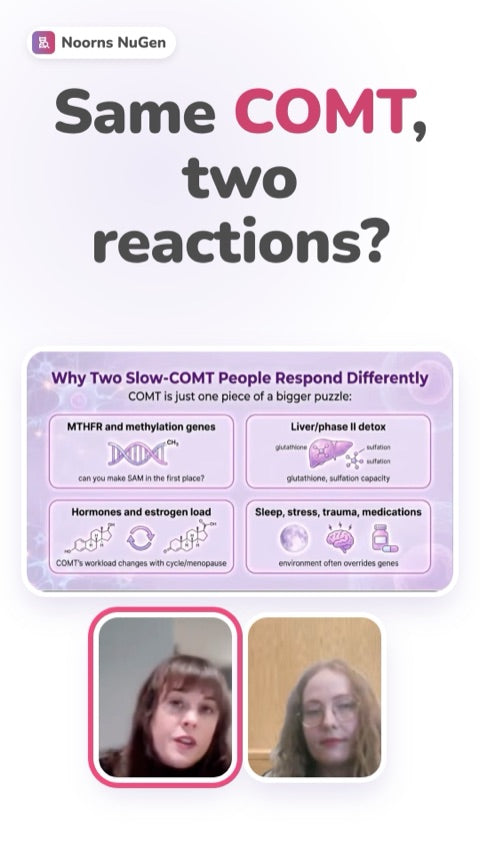
Host: Because we keep saying COMT is just one piece of the pit puzzle. We're much more than just one gene. So MTHFR and your other methylation genes, are you even making SAMe in the first place? Do you have variants in both MTHFR and MTHFD1? How is your liver phase two detox?
How is your glutathione production, your sulfation, capacity, your hormones and estrogen load? Or do you have estrogen dominance? Then COMT is having a lot more work to do, stress, sleep, trauma. I mean, even if you're a fast COMT, it doesn't matter if you still experience a life-changing trauma, traumas, trauma.
And also, you know, for slow COMT, then it's just harder to deal with. You know, it's, we're more than just one gene and our environment shapes us greatly. Medications can cause side effects and interact with COMT as well. So all these are different key pieces to your puzzles that you need to find to work together.
24:50 How does a nutrigenomics report help?
Host: So how does a nutrigenomic DNA report help? So there's a lot of nutrigenomic reports out there, that you can get, besides the Noorns one, of course. But what you want to do is you want to look at your COMT and your other variants because they are cumulatively significant.
You really want to look at MTHFR, [inaudible], and other methylation and neurotransmitter genes. Your detox capacity and nutrient needs. So which supplements to start with and what dose and what things to avoid, those, that information is given in the Noorns reports. [Another DNA tool] does this, I believe, as well, but it's just per gene instead of the Noorns reports are cumulative. [A remark about another company's pricing is left out.]
Guest: I, I'm, I'm not the biggest fan of it. It could be because it can offer, kind of confusing information because they will label, you know, the, intermediates as red or they do that.
Host: Kind of leave people with more questions than answers.
Guest: But, but if, if they are able to consult someone who can interpret it for them, sure. Yeah. It's free.
Host: Yeah. The Noorns reports are $29. [Update, October 2026: the Methylation and Diet Report is still $29 in the US; other reports are now priced from $29 to $99.] So they're not, unaffordable.
Guest: They're my personal favorite. I think so much, really, I, I'm so proud of the reports and I really wouldn't recommend anything else. I think they're so detailed. I think they're so easy to read. And when you get to each gene, like, I'm not kidding. It's, it's, it's not like, you know, big extravagant language that you're trying to like, she's, what she has created, is really easy to read stuff.
And then there's, the, suggestions and then there's the, like the recommendations and then the avoids. It's really great. Yeah. Huge believer. Big fan.
Host: Aw, thank you so much, [guest]. Yeah. That's great. Thanks. So slow COMT and high estrogen, you get a lot more, I think you have more information about this than I am because you're also an estrogen dominance group as well.
Guest: Yeah, I've been studying this for a long time. So, I mean, with, with slow COMT and high estrogen, that could be a whole nother episode that we would have to talk about. There's that much information to go into, of things to avoid or things to, maybe incorporate into your lifestyle.
But, as far as like what we have here, sure. Sleep, stress management, magnesium, your, your, your methylation vitamins are essential to, to, metabolizing and detoxing estrogens. And like what we were talking about before, estrogen, there's several phases of detox that it needs to go through to be, inactivated because, some of these estrogens are carcinogenic.
So, so looking at this, we've got month one, sleep, stress management, magnesium, B2, B6, basic minerals. Sound advice, month two, add low methyl folate, B12. If you're low on B12 might help. If you, if you are low in folate, I would add B12 first, but anyway, okay, I'm getting off track.
The whole point is, that I think, with the estrogen metabolism one, I would like to see us do a whole nother episode on that because there's just. Yeah, that's a great idea.
Host: We can ask in the comments.
Guest: I don't even know how to condense it right now in about two minutes. No, no, absolutely not, but let us know in the comments.
Host: I'll take questions on it though.
Guest: I'm happy to. Yeah.
Host: And let us know if it's something you'd like us to do a whole, presentation on. So key takeaways for our slow COMT. So COMT controls, dopamine and estrogen clearance. Your genes determine how fast and slow you clear them. Slow COMT needs gentle, low dose cofactor based support, not stimulants or high methyl donors.
Why supplements may feel different. Two people with the same gene variant can have completely different responses based on MTHFR detox hormones and lifestyle. Genetics plus symptoms plus labs. That's the information you want. So we are more than just our genes.
29:05 Fast COMT patterns: feeling flat and what can help
Host: You need to know your symptoms and you need to know your labs before you can start implementing real changes as well. Now we're finally going to get to the fast COMT. So, sorry if you guys have been holding on for the fast COMT and we've just been focusing on the slow.
So why fast COMT can feel flattened, unmotivated. Again, your Pac-Man is just running really quickly through all of your dopamine and norepine, sometimes too quickly. This leads to a low dopamine baseline, flat mood, low motivation, and fatigue. This can also cause poor working memory and focus without, stimulation.
Less pleasure from rewards and anhedonia-like symptoms need for external stimulation, like, the caffeine, exercise, the novel novelty, thrill-seeking stuff. Again, if you like extreme sports, something like that, because you need to feel on and you get that dopamine surge.
So the irony for the fast COMT needs more dopamine support, not less, but in a way that doesn't overshoot because you don't want to then exacerbate and, have negative symptoms from that. So supplements that slow COMT. Polyphenols and natural COMT inhibitors. Quercetin. 250 to 500 milligrams daily.
It's a bioflavonoid that gets inhibited by COMT allowing dopamine to accumulate without overstimulation. High doses of curcumin. 500 to 1000 milligrams daily. It's a potent COMT inhibitor with very, strong anti-inflammatory benefits. So if you have an inflammatory condition, you do need to be careful with this interference with medication.
But, if you have something like, fibromyalgia, rheumatoid arthritis with high CRP markers, this might be a great one for you because you're hitting a few birds with one stone. High doses of EGCG. So this is green tea extract. We, we have people in the group that can't tolerate even a cup of green tea, but you know, in, in the literature, it's usually a very high doses of the EGCG that inhibit COMT.
It may be something else going on when you can't drink any forms of it. That's often discussed and, talked about as a big avoidance. How gentle dopamine support interacts with the brain for fast COMT. So L-theanine is [inaudible] focus. It modulates neurotransmitters, dopamine, and serotonin.
Low doses of tyrosine. This is the precursor to convert to dopamine. It supplies, sustained building blocks for dopamine synthesis. You can, Mucuna pruriens or L-DOPA. Be careful with these. You cannot take these if you are on other neurotransmitter medications.
But it bypasses the rate limiting step converting direct to dopamine. But this is all, these are all supplements you should discuss with your doctor if you want to start taking them. But they are, they do provide steady dopamine support, without overwhelming the fast clearing COMT system.
So intermediate COMT. Those are, are one fast allele and one slow allele are Val/Met. This one is kind of the best of both worlds where you can play with it with what you need. If you're going to know you're going to have a very stressful situation. Like you have to do a live stream presentation and you're stressed.
Then don't take anything that's going to inhibit your COMT even further because you're gonna not tolerate that stress as well. So you can, and if you are feeling, flat and low energy, you can increase your dopamine with the, things we just talked about. The L-tyrosine and L-DOPA.
Caffeine and moderate exercise. You can slow down COMT with [inaudible]. If you're anxious or you're going to be handling a lot of stress, avoid these first two things and instead focus on the magnesium L-theanine and methylation support.
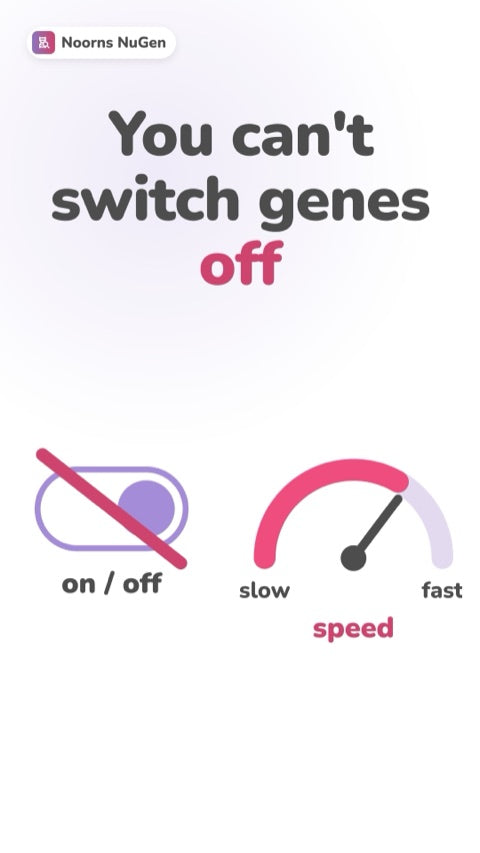
Guest: Well, I do want to say one thing about this that I think is really important. So, you know, there's this common misconception that you can turn genes on and off. And I do the air quotes because, I know that's a, that's a popular phrase and people catch on. And I think it's, it's a really skewed idea because, you cannot in fact turn genes on and off.
Genes are always expressing. We are genetics. Genes express that slow, intermediate, and fast. What we are able to do is, by implementing, supplements, you know, to either inhibit or induce COMT, you can control the speed at which, it expresses. So like, you know, with, if you're, if you're, if you have fast COMT and, it's too, too fast, you can inhibit it by possibly taking something like quercetin or, you know, some EGCG, slow it down.
So, we are able to control our genetics, and, expression. And I think that's really cool. I just, I just wanted to clarify that. Yeah.
Host: It doesn't mean it's turned on or off by any means, because if it was turned off, then, you know, you wouldn't be existing.
Guest: Right. Yeah, exactly. Yeah. So I just really wanted to, but I think, I think that's also, it gives me, it gives me a lot of hope, you know, I'm like, oh, that's cool that we're able to have that much control that we can control these things. And like, if you are slow COMT, it's not a death sentence that you're just going to be an anxious person.
There's things you can do. And if you're fast COMT, you know, there's things you can do. So, and, and even with intermediate, you can swing in either direction. If with me, I'm intermediate COMT. And if I take a lot of quercetin and a lot of COMT inhibitors, I start to develop what is slow COMT.
And then, you know, you can kind of swing in either direction. So.
Host: Excellent point. That one. And, the turning genes on and off. And then my other favorite one to hear is, the, I have the MTHFR gene or I have the COMT gene. I'm like, yes, yes, you do. Yes. Everybody does. Everybody has it. Yes. You know, people are new to the world of genetics.
So I always find that kind of cute. Yeah. Yeah. So yeah, that was a great segue to our very last slide too, with like, you're not broken. Your genes, just need the right support. So we can influence the expression of our genes through our diet and our lifestyle and our choices.
We haven't gotten any, comments. I can check the Facebook page really quick and see if anybody has posted there, but, [guest], do you want to, do we have any, like, frequently asked questions we usually get in the Facebook chat just to answer a few questions.
The short versions
Short clips from this session, each on one part of the story.