APOE in your DNA file: can you find your type?
Can your raw DNA file show your APOE type? APOE is read from two markers, rs429358 and rs7412, and not every consumer DNA test reads both. This video shows how to check your own file in two minutes, what it means if one marker is missing, and what's worth doing for your brain whatever your type.
 The full articleNot All DNA Tests Read the Same Genes. Here's What That Means for APOE.Read it, with every source
Transcript
Everything said in the video, under the same chapters. Press a time to play from there.
0:00 What APOE is, and what e4 does and doesn't mean
Can your raw DNA file show your APOE type? Some files only hold half the answer. APOE is the gene people tend to worry about when it comes to memory. It comes in three common versions, e2, e3 and e4. The Alzheimer's Association estimates that between forty and sixty-five percent of people diagnosed with Alzheimer's carry e4.
If that number makes your stomach drop a little, hold on to this part too. Carrying e4 raises the odds. It doesn't settle the outcome, and plenty of people with e4 never develop the disease.
0:39 The two markers that make your APOE type
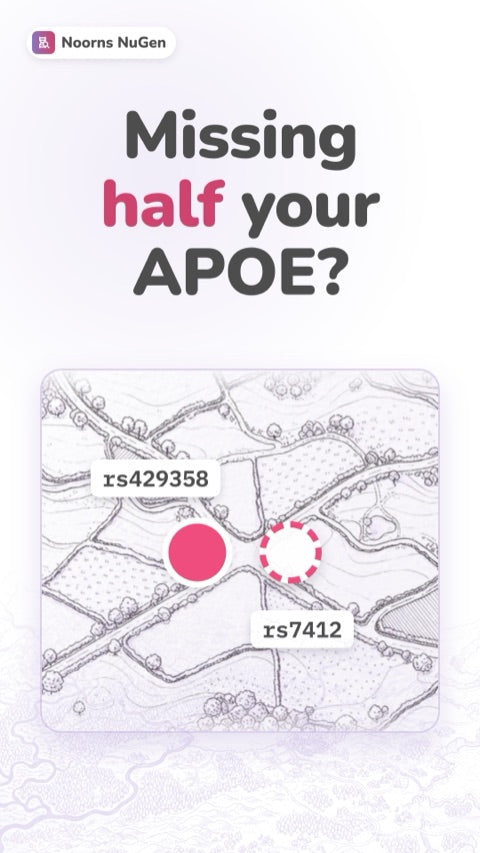
Your APOE type is a pair, one version from each parent. And it's read from two markers that sit right next to each other in your DNA. They're called rs429358 and rs7412. You need both. With only one, you're missing half the answer.
0:58 Why your DNA file might be missing one
A consumer DNA test doesn't read all of you. It reads a fixed list of several hundred thousand markers, and each company chooses its own list. And a company can change that list over time. Here's a real example. An AncestryDNA file downloaded in late 2022 has about six hundred and sixty-nine thousand markers. rs429358 is in it. rs7412 isn't there at all.
Other files differ in other ways. The only way to know what's in yours is to look.
1:32 How to check your own file
First, decide whether you want to know. Plenty of people would rather not, and that's a reasonable choice. Two US genetics bodies advise against APOE testing to predict Alzheimer's, and say any genetic testing for it should come with genetic counseling. If you do want to look, open your raw file in a plain text editor.
Search for rs429358, then rs7412. If both are there with letters, you can read your pair from the table in our blog post. A line with no letters means the test looked and couldn't get a reading. No line at all means your file doesn't include that marker. One more thing for Ancestry files.
A public genetics database reports that Ancestry data always shows TT at rs429358, even for people whose other files show CT. So a TT there doesn't rule out e4.
2:29 If your file has only one of the two
If your file has only rs7412, a neighboring marker can give a rough estimate. In people of European ancestry, it picks up about seven in ten e4 carriers. In people of African ancestry, about one in four. That's why our Cognitive Health and Memory report calls it an indication, not a confirmation.
And if your file is missing rs7412, the report can't show an APOE type at all. Everything else in it still works. If you do see e4, especially two copies, talk to your doctor or a genetic counselor.
3:05 What's worth doing whatever your type
Now the bigger picture. A large 2026 study mapped ninety-one regions of the genome tied to dementia risk. And a 2024 Lancet Commission estimated that around forty-five percent of dementia cases could in principle be prevented or delayed by changing fourteen risk factors.
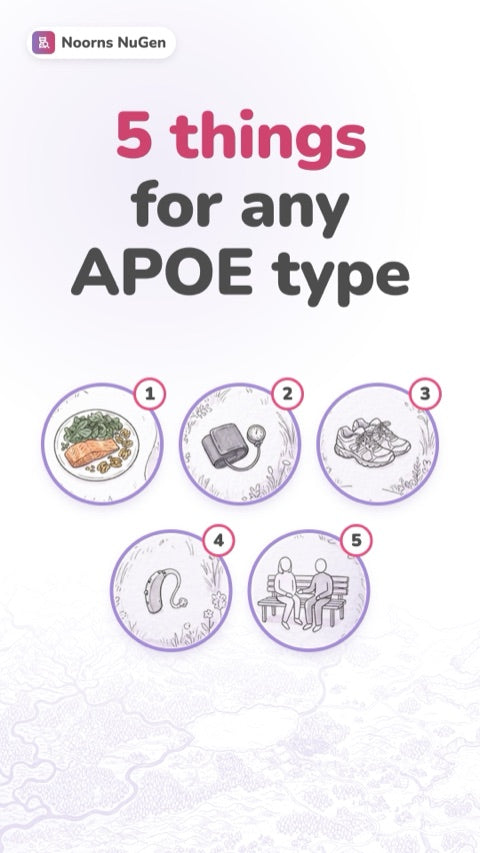
So whatever your file says, watch the saturated fat on your plate, know your blood pressure and cholesterol, stay active, look after your hearing, and see people. A walk to lunch with a friend can cover three of those at once.
3:40 Two minutes, and where to go next
If you've decided you want to look, it takes two minutes and it's free. Open your file and search for those two markers. And if you'd like the full picture, our Cognitive Health and Memory report reads more than a hundred and sixty markers across thirty-eight genes, right in your browser.
You'll find it at noorns.com.
Sources
The studies and statements behind each point in the video.
The short versions
Three one-minute videos, each on one part of this story.