
In this post
Many people turn to nutrigenomics testing for personalized insight into how their genes interact with nutrition. Yet an independent review of 45 direct‑to‑consumer nutrigenetics services, Direct‑to‑Consumer Nutrigenetics Testing: An Overview, revealed that not all reports are created equal. The researchers found recurring gaps: missing rsIDs (reference SNP identifiers), limited references, unclear weighting, vague disclaimers, and often no sample report at all. These issues can make even good science hard to interpret.
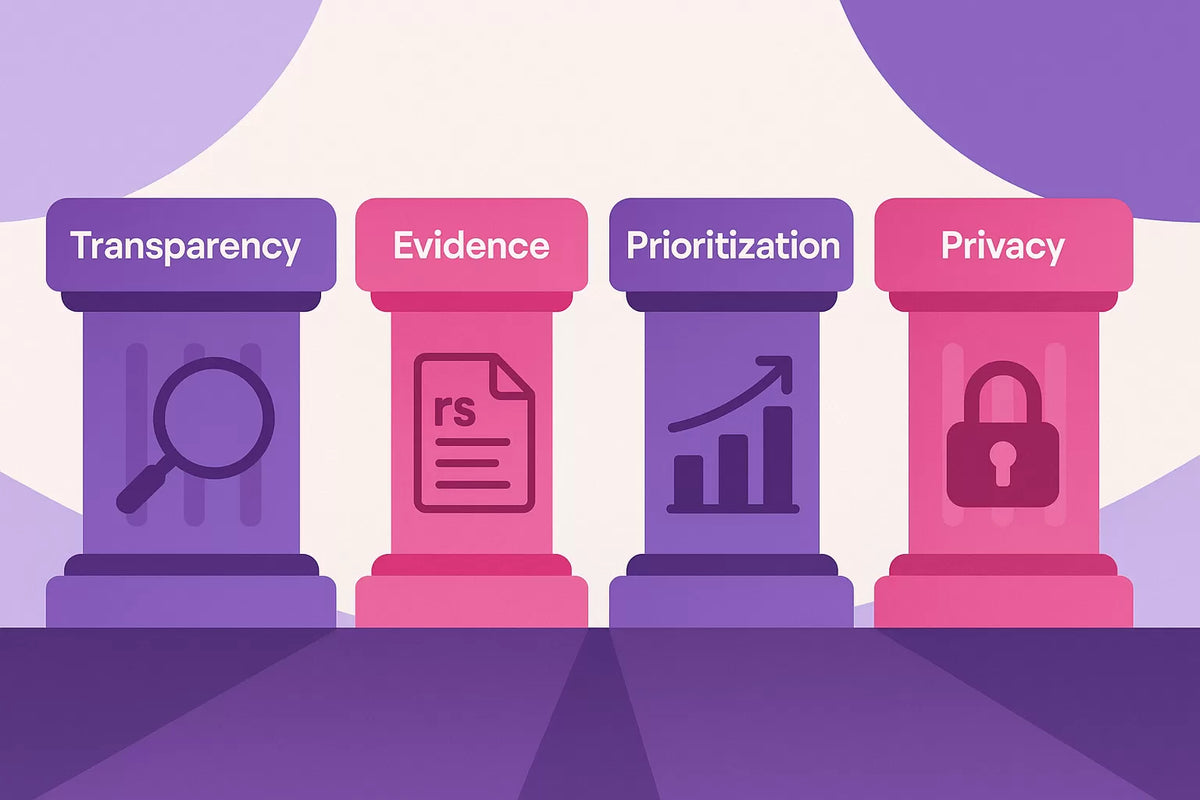
The goal is not to discourage genetic testing but to highlight what a trustworthy report should include. Noorns was built with that in mind. Each report addresses the same problem areas the review identified, focusing on four key pillars: transparency, evidence, prioritization, and privacy. Together these pillars turn genetic data into clear, contextual, and responsible guidance that readers can actually use.
Open a Noorns report and you will see these pillars in practice.
Transparency Gives You Better Decisions
A trustworthy report should show its work. In a Noorns report, every section that interprets a gene lists the specific variant identifier (rsID, a database ID for a genetic variant), your allele call (the version of that variant you carry), and linked primary research sources. You can click through to PubMed or PMC to see exactly where each claim comes from and how strong the finding is.

Example Noorns report page showing rsIDs, your allele, risk allele, a concise Notes field tied to evidence, and Focus and Avoid actions.
What this shows:
- Variant-level transparency with rsIDs and allele calls.
- A Notes field that connects each genetic finding to its evidence.
- Focus and Avoid actions grouped in one place to reduce decision fatigue.
Transparency shows why a recommendation appears. The next question is how strong the evidence is.
Evidence That Is Visible and Bounded
Genetics for nutrition often relies on Genome-Wide Association Studies (GWAS). GWAS scans many genetic markers across large groups to find links with a trait. It identifies patterns, not direct causes. Effects are usually small, and environment, food, and lifestyle still play a major role.
The FTO example above, taken from a real Noorns report, shows how the science appears in context. Each recommendation sits beside the variant IDs that inform it, the linked studies that support it, and a short note explaining the size and limits of the effect. This approach keeps the science visible, sets expectations clearly, and helps you focus on what you can actually influence.
With the evidence in view, the next step is deciding what to do first.
Prioritization Beats Noise
Many reports deliver long lists of suggestions without showing which ones matter most. Noorns takes a different approach by ranking actions in order of importance.
Each recommendation is weighted using variant counts, study quality, and direction of effect, and this process is described at a high level in every report. The result is a short, ranked plan showing which nutrition or lifestyle choices have the clearest support for you.
When findings conflict, such as one variant suggesting more folate while another advises caution, Noorns shows both, labels the tension, and explains which signal carries more weight. You will see Focus actions and Avoid notes side by side with reasoning. This structure saves time and prevents confusion between competing tips.
Once you know what to do, the final step is keeping your data safe while you do it.
Privacy by Design Is a User Right
Genetic data is personal, powerful, and permanent. In European law it is treated as special category data under GDPR Article 9, meaning it requires stronger protection.
At Noorns, privacy is not an add-on. It is built into the product. Your report is processed on your device, with no uploads and no storage. You get interpretation without sharing or saving your genome anywhere. This approach follows the principle of data minimization and ensures you stay in full control of your information.
Privacy is not only a technical choice. It is a promise that you can learn from your DNA without giving it away.
How Noorns Shows Its Work
Every part of a Noorns report is designed for clarity and traceability.
- Variant transparency: Each claim lists the rsID and your allele call. Multi-SNP traits show the full set.
- Linked bibliographies: Each gene section lists references with live PubMed or PMC links.
- Interpretation guide: Plain language explains result status, what an elevated risk means, and why most effects are modest.
- Prioritized actions: Focus and Avoid items appear with short explanations and links to supporting studies.
- Limits and disclaimers: Each report explains what can and cannot be inferred and encourages clinician input for health conditions or supplement use.
These practices turn technical data into a readable, verifiable report you can use.
What to Look For Before You Buy
If you are comparing DNA nutrition reports, use this checklist to tell who is doing it right.
- Variant proof. Are rsIDs and allele calls shown for every claim?
- Linked sources. Do claims link to peer-reviewed research, not marketing material?
- Evidence context. Is GWAS explained in plain language with its limits acknowledged?
- Prioritization. Are recommendations ranked, and is the weighting method described?
- Conflict handling. Does the report address opposing findings and explain how they are resolved?
- Privacy. Are the company’s data practices explained clearly? Whether analysis is done on-device or in the cloud, privacy policies should be transparent about how genetic data is handled, stored, and protected.
- Limits and disclaimers. Does it avoid medical claims and suggest consulting a clinician?
- Sample report. Can you preview the structure and level of detail before buying?
Transparency and privacy are easy to claim. This checklist helps you verify who truly delivers them.
What Sets a Reliable Report Apart
Not all nutrigenomics reports meet the same standard. The independent review documented common weak points: missing rsIDs, thin references, unclear weighting, and vague limits. A reliable report does the opposite. It shows its work, sets expectations, and turns signals into a short plan while respecting your data.
Noorns is built around that standard. We:
- show rsIDs and your allele next to each claim, with primary sources;
- describe strength and limits in plain language;
- rank actions and explain how conflicts are resolved;
- process reports on your device and do not store DNA files.
The point is confidence, not hype. When you can see the variant, read the study, understand the caveats, and act in order, genetics becomes useful. When privacy is clear, it feels safe to learn.
Whether you choose Noorns or another provider, use the checklist above. Choose reports that earn trust by making the science, the plan, and the privacy obvious.


